
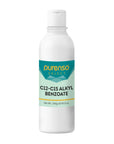

C12-C15 Alkyl Benzoate

C12-C15 Alkyl Benzoate

Size 100g
Adding to Cart Added to Cart
Description C12-15 Alkyl Benzoate is a lightweight, fast-absorbing cosmetic emollient that enhances the texture and spreadability of skincare, sunscreen, makeup, and hair care formulations. It delivers a silky, non-greasy feel, reduces oiliness, and improves the overall sensory experience of finished products. Widely used as a solvent for UV filters and pigments, it helps create elegant, high-performance formulations.
Functions
  • Emollient – Provides a smooth, soft, silky skin feel.
  • Texture Enhancer – Improves spreadability and formulation elegance.
  • Non-Greasy Ester – Reduces the oily feel of heavy oils and butters.
  • Solvent – Helps dissolve UV filters and oil-soluble ingredients.
  • Pigment Dispersant – Aids uniform pigment distribution in makeup products.
  • Sensory Modifier – Enhances absorption and reduces tackiness.
  • Carrier Oil Alternative – Delivers lightweight emolliency without heaviness.
INCI C12-15 Alkyl Benzoate
Appearance Clear liquid
Usage rate C12-15 Alkyl Benzoate is typically used at 3–10% in cosmetic formulations, though usage levels can range from 1–20% depending on the application. It is commonly incorporated at 2–15% in creams, lotions, and makeup products, 5–20% in sunscreen formulations, and 2–10% in hair care products and serums. The usage level can be adjusted to achieve the desired skin feel, spreadability, and reduction of greasiness in the final formulation.
Applications C12-15 Alkyl Benzoate is widely used in moisturizers, creams, lotions, serums, sunscreens, foundations, BB/CC creams, tinted products, lip formulations, hair serums, leave-in conditioners, and styling products. It is particularly valued in formulations requiring a lightweight, non-greasy skin feel, improved spreadability, enhanced pigment dispersion, and efficient solubilization of UV filters.
pH Not applicable.
Charge Non-Ionic
Solubility

C12-15 Alkyl Benzoate is oil-soluble and readily miscible with most cosmetic oils, esters, silicones, UV filters, and lipophilic ingredients. It is insoluble in water, making it ideal for use in the oil phase of emulsions, sunscreens, makeup products, and hair care formulations.


Why do we use it in formulations? C12-15 Alkyl Benzoate is used to provide a lightweight, silky, and non-greasy skin feel, improve the spreadability of formulations, reduce the heaviness of oils and butters, and enhance the performance of sunscreens and makeup by helping disperse UV filters and pigments evenly.
Alternatives & Substitutions Alternatives & Substitutions: Based on products currently available on Purenso Select, suitable alternatives to C12-15 Alkyl Benzoate include Isopropyl Myristate (IPM), Isoamyl Laurate, Evogreen L19 (Emogreen L19 Alternative), Exfeel Wow (LexFeel WOW Alternative), Isododecane, Hydrogenated Polyisobutene, Olive Squalane (Phytosqualane), and Medium Chain Triglycerides (MCT Oil / Caprylic-Capric Triglyceride). The best substitute depends on the desired skin feel, spreadability, volatility, and formulation type.
Benefits
  • Lightweight, non-greasy emollient
  • Improves spreadability and skin feel
  • Fast absorption with a silky finish
  • Reduces oily and sticky sensations
  • Excellent solvent for UV filters
  • Enhances pigment dispersion in makeup formulations
  • Improves formulation elegance and aesthetics
  • Compatible with a wide range of cosmetic ingredients
  • Suitable for skincare, hair care, sunscreen, and color cosmetics

Polyquaternium 7Polyquaternium 7Polyquaternium 7Polyquaternium 7

This product is a cosmetic raw material and is intended for external use only in cosmetic and personal care formulations. It is not intended for internal consumption or medicinal use.

  • Do not ingest.
  • Keep out of reach of children.
  • Avoid direct contact with eyes.

All product images are for illustrative purposes only. Actual product color, texture, or packaging may vary from batch to batch.

Information provided on this website is for educational purposes only and should not be considered or interpreted as medical advice.

While we do not offer products for internal use, we source only high-quality, pharmaceutical or food-grade ingredients. Ingredient purity and performance are critical in cosmetic applications, just as they are in ingestible products.

Please note:
Just because two products have the same name or CAS number does not guarantee the same grade, purity, or effectiveness. Always choose trusted suppliers. Choose Purenso for premium-grade ingredients you can rely on.

FREQUENTLY ASKED QUESTIONS

No. They are different ingredients with different formulation roles. C12-C15 Alkyl Benzoate is used as an emollient and solvent, not as a replacement for a validated preservative system. The shared benzoate wording does not establish equivalent antimicrobial function.

Do not confuse wetting with dissolving. It can help wet and distribute suitable powders, but mineral particles generally remain dispersed solids. A uniform colour still needs an appropriate dispersion process and enough structure to keep the particles distributed.

Wetting helps distribute particles but does not by itself create a suspension network. Review agglomerates, processing and the structure of the complete liquid. Test sedimentation and redispersibility in the intended pack rather than adding more solvent and expecting permanent suspension.

No. An emollient or solvent does not take over the emulsifier's role in stabilising oil and water. Keep a suitable emulsifying system and evaluate the revised oil phase. An initially smooth mixture is not proof of long-term emulsion stability.

No predictable SPF number follows from adding the ingredient. Solvent choice can influence a sunscreen system, but protection is a property of the complete tested product. Do not use an emollient percentage as a calculation for SPF or omit required finished-product testing.

Warm clarity does not prove that the ingredient remains dissolved at lower temperatures. Review the complete solvent blend and the amount of solute, then observe cooled and stored trials. Reheating to clarity is not, by itself, a permanent stability correction.

Extra oil-phase material changes the formula total and emulsion balance. Compare a controlled replacement within the existing oil phase before considering an addition. Recheck viscosity, stability and skin feel rather than assuming a lighter-feeling emollient cannot destabilise a finished cream.

They can have separate roles within an appropriately designed emulsion: niacinamide belongs in the compatible water phase and Alkyl Benzoate in the oil phase. Confirm the complete system's pH, processing and stability rather than trying to dissolve the powder directly into the emollient.

Stick firmness depends on the interaction of the liquid oil phase with waxes and other structurants. Changing the emollient can alter that structure. Compare cooling behaviour, application and warm-storage stability instead of assuming the original wax level will always give the same hardness.

It may alter pigment wetting, dispersion and the optical appearance of the finished film even when the pigment weight is unchanged. Compare drawdowns made at the same film thickness. Do not approve a colour match only by looking at the product in the mixing vessel.

Do not assume the foundation tolerates extra solvent or oil. The change can affect pigment distribution, emulsion stability, coverage and preservation. Reformulate a suitable base under controlled conditions rather than altering a retail product and expecting the original performance claims to remain valid.

No. The complete oil blend, fragrance, colourants, application amount and fabric determine residue. Compare the finished product on representative fabrics and after drying. A sensory description such as dry feel is not a universal fabric-compatibility claim.