
Buy Online Carboxy Methyl Cellulose (CMC) / Sodium CMC in India - Purenso Select

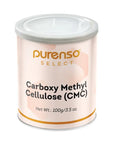
Carboxy Methyl Cellulose (CMC) / Sodium CMC

Size 100g
Adding to Cart Added to Cart

Carbo Methyl Cellulose (CMC) or Cellulose Gum is mainly used to thicken and to stabilize cosmetics but due to its polymeric structure that acts as film forming agent, CMC is also used to improve moisturizing effects, where its good binding, thickening and stabilizing properties are utilized. One of the main CMC applications in the cosmetic industry is the toothpaste formulation.

CMC is mainly used to thicken and to stabilize cosmetics but due to its polymeric structure that acts as film forming agent, CMC is also used to improve moisturizing effects. Water-soluble.

Benefits:
  • Contribute to thickening, bonding, dispersing, suspending, homogenization, emulsifying and stabilizing
  • Can be absorbed by the skin to prevent dry skin

Texture: Creamy white, odorless free flowing powder

Use: Skin care, facial care, oral care, toothpastes, denture creams & powders.

Applications: Typical use level 0.5-4% depending on the type of formulation desired viscosity. For external use only.

Ingredients: Carboxy Methyl Cellulose (CMC)

Carboxy Methyl Cellulose (CMC) / Sodium CMCCarboxy Methyl Cellulose (CMC) / Sodium CMCCarboxy Methyl Cellulose (CMC) / Sodium CMCCarboxy Methyl Cellulose (CMC) / Sodium CMC

This product is a cosmetic raw material and is intended for external use only in cosmetic and personal care formulations. It is not intended for internal consumption or medicinal use.

  • Do not ingest.
  • Keep out of reach of children.
  • Avoid direct contact with eyes.

All product images are for illustrative purposes only. Actual product color, texture, or packaging may vary from batch to batch.

Information provided on this website is for educational purposes only and should not be considered or interpreted as medical advice.

While we do not offer products for internal use, we source only high-quality, pharmaceutical or food-grade ingredients. Ingredient purity and performance are critical in cosmetic applications, just as they are in ingestible products.

Please note:
Just because two products have the same name or CAS number does not guarantee the same grade, purity, or effectiveness. Always choose trusted suppliers. Choose Purenso for premium-grade ingredients you can rely on.

FREQUENTLY ASKED QUESTIONS

Not reliably. Emulsifiers differ in chemistry, oil-phase capacity, required process and finished texture. Rebalance and retest the formula rather than swapping by weight alone.

Droplet size, heating, mixing, oil load, electrolytes and cooling profile all affect long-term stability. Stability testing is needed beyond the first 24 hours.

No. Too much emulsifier can worsen feel or still fail if the phase ratio and process are wrong. Diagnose oil load, temperatures, mixing and incompatible ingredients first.

Many hot-process emulsions perform more consistently when phases are appropriately heated before combining, but follow the guidance for the exact emulsifier grade.

Yes. Electrolytes and pH changes can affect some emulsifiers and thickeners. Add challenging ingredients in controlled trials and monitor viscosity and separation.

Only if the exact grade and formulation method support cold processing. Do not assume a hot-process emulsifier will work identically without heat.

Emulsifier level, fatty alcohols, oils, cooling and mixing can all influence after-feel. Adjust the whole oil-phase structure rather than changing one ingredient in isolation.

Some emulsifier systems contribute body, but viscosity and emulsion stability are different functions. A separate rheology modifier may still be needed.

Add at a temperature appropriate for the fragrance and emulsion, then mix thoroughly. Fragrance can affect viscosity or stability, so check the finished product after ageing.

Change one variable at a time: phase ratio, emulsifier level, temperature, mixing and electrolyte load. Keep batch records so the cause of improvement or failure can be identified.