


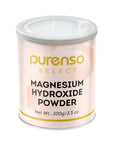


Magnesium Hydroxide Powder
Magnesium Hydroxide Powder – Deodorant Ingredient, Absorbent & pH Buffer
Magnesium Hydroxide Powder is a fine, white mineral-based cosmetic raw material used as an absorbent, buffering agent, pH adjuster and formulation texturizer. It is especially valued in natural deodorant formulations, where its low water solubility and alkaline nature can help neutralise acidic malodour compounds without functioning as an antiperspirant.
It is suitable for deodorant creams, deodorant sticks, body powders, foot-care products, mattifying powders, shaving preparations and selected skincare formulations. Magnesium Hydroxide is officially recognised in cosmetic ingredient references for its absorbent and buffering functions.
Unlike highly soluble alkaline powders, Magnesium Hydroxide remains primarily dispersed within a formulation rather than dissolving completely. This allows formulators to use it in baking-soda-free deodorant concepts, although the final concentration, product pH and skin compatibility must always be evaluated.
Key Benefits:
- Supports odour-control performance in deodorant formulations
- Helps neutralise acidic malodour compounds
- Functions as an absorbent in body and cosmetic powders
- Provides body and texture to creams, balms and powder products
- Can be used as a buffering or pH-adjusting ingredient
- Fine white powder with no significant inherent odour
- Suitable for deodorant formulations made without sodium bicarbonate
- Can be used in formulations positioned without aluminium-based antiperspirant salts
- Suitable for both anhydrous and emulsified systems when properly dispersed
- Does not block perspiration and should not be described as an antiperspirant
Cosmetic Functions:
Absorbent: Helps take up oils, moisture and finely dispersed substances within cosmetic formulations.
Buffering Agent: Helps control and stabilise the pH of suitable formulations.
pH Adjuster: Can gradually neutralise acidic components and increase formulation pH.
Filler and Texturizer: Adds body, opacity and powder structure to deodorants, creams and colour cosmetics.
Magnesium Hydroxide is commonly described as an absorbent, filler, texturizer and buffering or neutralising ingredient in cosmetic formulations.
Recommended Applications:
Magnesium Hydroxide Powder can be used in:
- Natural deodorant creams
- Solid deodorant sticks
- Deodorant balms
- Baking-soda-free deodorants
- Body powders
- Foot powders and foot-care products
- Odour-control body products
- Mattifying face powders
- Loose and pressed cosmetic powders
- Creams and lotions
- Shaving creams
- Selected face masks
- Anhydrous body-care formulations
Typical Usage Level:
| Application | Suggested Starting Range |
|---|---|
| As a pH adjuster or buffer | 0.2–1.5% |
| Creams, lotions and masks | 0.5–5% |
| Deodorant creams and sticks | 5–20% |
| Absorbent, filler or texturizer | 1–30% |
How to Use Magnesium Hydroxide Powder: Magnesium Hydroxide is practically insoluble in water and ethanol. It should therefore be dispersed rather than treated as a water-soluble ingredient.
For Anhydrous Deodorant Creams and Sticks
- Sift the Magnesium Hydroxide Powder before use.
- Pre-disperse it in a small portion of the formulation’s liquid oil or emollient.
- Mix until a smooth, lump-free paste is obtained.
- Add the dispersion gradually to the melted oils, butters or waxes.
- Maintain sufficient agitation while the product cools to minimise settling.
- Test the final product for graininess, white residue, spreadability and odour-control performance.
For Creams and Lotions
- Prepare a smooth slurry using a portion of the water phase, glycerine or propanediol.
- Add the slurry gradually with moderate-to-high shear mixing.
- Continue mixing until the powder is uniformly dispersed.
- Use an appropriate suspension or rheology system where required.
- Check the final pH after manufacture and again after the formulation has equilibrated.
For Body and Foot Powders
Pass the Magnesium Hydroxide through a suitable sieve and blend gradually with starches, clays or other powders until uniformly distributed.
INCI Name: Magnesium Hydroxide
Solubility: Practically insoluble in water and ethanol; dispersible in suitable formulations
Function: Absorbent, buffering agent, pH adjuster, filler and texturizer


This product is a cosmetic raw material and is intended for external use only in cosmetic and personal care formulations. It is not intended for internal consumption or medicinal use.
- Do not ingest.
- Keep out of reach of children.
- Avoid direct contact with eyes.
All product images are for illustrative purposes only. Actual product color, texture, or packaging may vary from batch to batch.
Information provided on this website is for educational purposes only and should not be considered or interpreted as medical advice.
While we do not offer products for internal use, we source only high-quality, pharmaceutical or food-grade ingredients. Ingredient purity and performance are critical in cosmetic applications, just as they are in ingestible products.
Please note:
Just because two products have the same name or CAS number does not guarantee the same grade, purity, or effectiveness. Always choose trusted suppliers. Choose Purenso for premium-grade ingredients you can rely on.
FREQUENTLY ASKED QUESTIONS