


Zinc Ricinoleate
Zinc Ricinoleate is a highly effective odor-neutralizing ingredient derived from castor oil fatty acids. It traps and absorbs body-odor molecules without blocking pores or affecting the skin’s natural balance — making it the perfect eco-friendly alternative to synthetic deodorant actives like triclosan or aluminum salts.
At Purenso, we offer cosmetic-grade Zinc Ricinoleate with excellent dispersibility in emulsions and deodorant bases.
Solubility: Soluble in water, Partially soluble (better dispersion with heating and co-emulsifiers)
Odor: Mild to neutral
Benefits:
- Powerful odor neutralizer – binds and eliminates malodor molecules naturally.
- Aluminum-free & alcohol-free, gentle on skin.
- Vegan & GMO-free – derived from renewable castor oil sources.
- Non-occlusive – does not block pores or interfere with sweating.
- Works well in deodorant creams, sticks, roll-ons, and sprays.
-
Eco-friendly for clean-beauty formulations.
Applications:
- Deodorant sticks and roll-ons
- Cream & lotion deodorants
- Antiperspirant replacements
- Foot care and body odor products
- Natural & vegan deodorant brands
Usage Level: Use at 0.5 – 3 % depending on formulation type. For stronger odor-control, levels up to 5 % may be used in anhydrous bases.
Disperse Zinc Ricinoleate in oil phase at 60–80 °C with a co-emulsifier (such as Polyglyceryl-10 Laurate or PEG-40 Hydrogenated Castor Oil) for best results.
💡 Formulation Tip:
Zinc Ricinoleate is best incorporated into the oil phase and melted with a co-solubilizer such as Polyglyceryl-10 Laurate, PEG-40 Hydrogenated Castor Oil, or Propylene Glycol to create a uniform dispersion before adding to the emulsion.
INCI Name: Zinc Ricinoleate
💚 Why Choose Purenso Zinc Ricinoleate
- Premium cosmetic grade odor-neutralizer
- 100 % plant-derived from castor oil
- Verified Vegan, GMO-Free & Alcohol-Free
- Reliable supply & fast delivery across India and international markets


This product is a cosmetic raw material and is intended for external use only in cosmetic and personal care formulations. It is not intended for internal consumption or medicinal use.
- Do not ingest.
- Keep out of reach of children.
- Avoid direct contact with eyes.
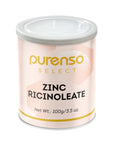
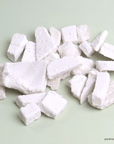
All product images are for illustrative purposes only. Actual product color, texture, or packaging may vary from batch to batch.
Information provided on this website is for educational purposes only and should not be considered or interpreted as medical advice.
While we do not offer products for internal use, we source only high-quality, pharmaceutical or food-grade ingredients. Ingredient purity and performance are critical in cosmetic applications, just as they are in ingestible products.
Please note:
Just because two products have the same name or CAS number does not guarantee the same grade, purity, or effectiveness. Always choose trusted suppliers. Choose Purenso for premium-grade ingredients you can rely on.
FREQUENTLY ASKED QUESTIONS